The era when a foreign bank account was synonymous with absolute confidentiality has officially come to an end. By 2026, the global financial system will operate on the basis of the automatic exchange of tax information between countries.
Today, the tax authorities can see foreign accounts through the automatic exchange system, which covers most financial jurisdictions. It is precisely through the CRS tax information exchange that data is regularly transmitted to the Ukrainian tax authorities. The question is no longer whether the tax authorities can see accounts abroad, but how exactly they analyse these data sets.
The global exchange of financial information did not appear overnight. Its foundations were laid by the United States with the introduction of the FATCA (Foreign Account Tax Compliance Act) system.
What is FATCA and how has it affected the global financial system?
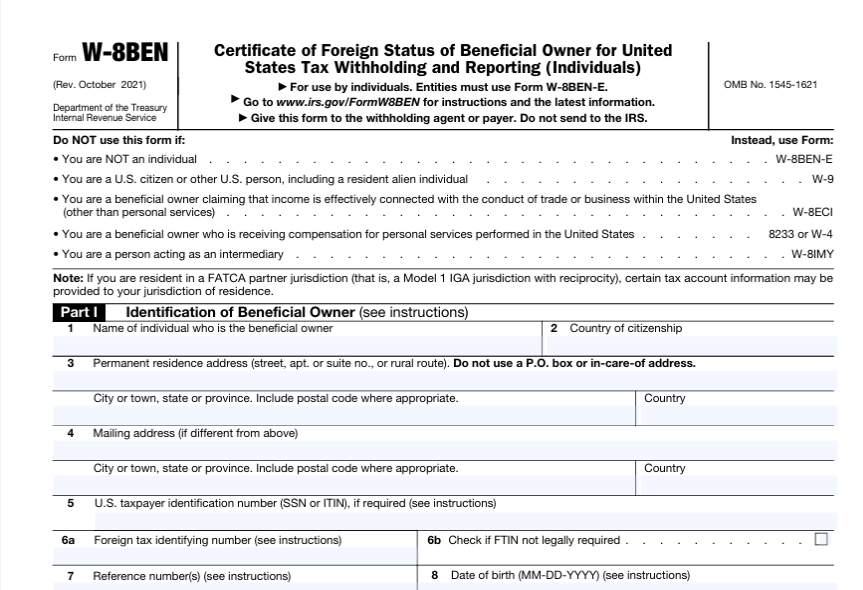
FATCA (Foreign Account Tax Compliance Act) is a US law passed in 2010 aimed at combating tax evasion by US citizens through the use of foreign financial accounts.
It was an unprecedented step for banks and financial organizations when financial institutions around the world were required to identify US tax residents and report their account information to the US Internal Revenue Service (IRS). That is why most countries were forced to adapt their legislation, which subsequently transformed the concept of banking secrecy in 2026 into full transparency.
In case of non-compliance with these requirements, significant sanctions are provided, including withholding 30% of income from US sources. That is why most countries, including Ukraine, were forced to adapt their legislation and join FATCA through international tax treaties.
Ukraine joined the global tax transparency system by signing an intergovernmental agreement with the United States: Agreement between the Government of Ukraine and the Government of the United States of America to improve the implementation of tax rules and application of FATCA provisions.
This agreement provides for a model of interaction whereby Ukrainian financial institutions report to the Ukrainian tax authorities, and they, in turn, transmit information to the United States.
The peculiarity of FATCA Ukraine is that the exchange is actually one-sided:
It is important that the implementation of FATCA has become part of a broader process of Ukraine's integration into the international system of automatic exchange of tax information, along with CRS.
What is CRS and how does tax information exchange work
The success of the US FATCA system has become a turning point for the global economy. Based on the US experience, the Organization for Economic Cooperation and Development (OECD) has developed a universal response to the global offshore problem - the Common Reporting Standard (CRS)
Whereas previously tax authorities had to send separate requests for each suspicious account, the CRS standard introduced the principle of automatic exchange of CRS tax information. This means that information about financial assets migrates between countries according to a clear schedule, without any additional justification or involvement of the account holder.
How CRS works: the mechanism of automatic information exchange
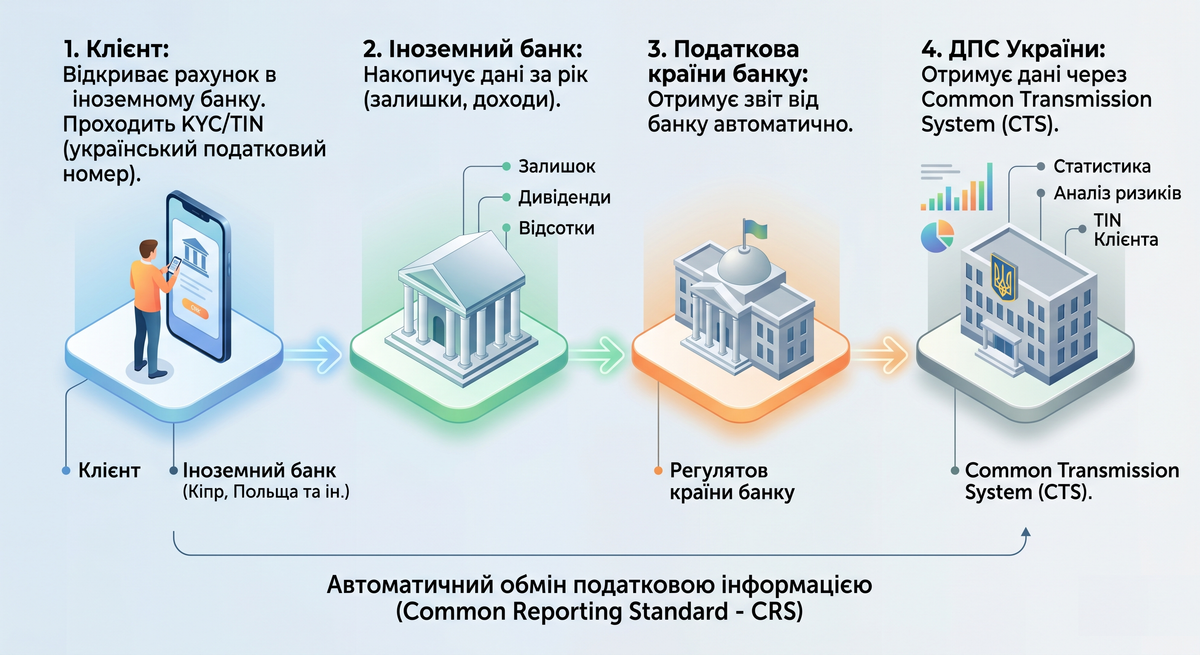
CRS involves an annual data exchange. Financial institutions carry out KYC/AML checks, collect account data, and transfer it to the State Tax Service. This is how the mechanism works through which the tax authorities see accounts abroad.
Financial institutions, including banks, payment systems, and investment companies:
identify the tax residence of the client;
conduct KYC and due diligence procedures;
collect information about financial accounts;
transmit this data to national tax authorities.
In turn, the tax authorities transfer the information to other jurisdictions where the client is a tax resident.
The following data is transmitted as part of the CRS tax information exchange:
Name, address of residence and tax identification number (TIN);
Bank account number;
Account balance;
Income (interest, dividends, investment income).
Thus, the CRS tax information exchange creates a global system where the tax authorities can see foreign accounts and investment accounts abroad in real time.
CRS Ukraine 2026: When the Tax Service Started Seeing Foreign Accounts
Many people ask: since when does the tax service see foreign accounts? The first CRS exchange in 2024 was the point of no return, after which the system started working at full capacity.
Key stages of CRS implementation in Ukraine:
2021 - Ukraine officially announced its intention to join the CRS
2022 - Multilateral Agreement on Automatic Exchange signed
2023 - Law No. 2970-IX and financial monitoring procedures were launched
2024 - the actual launch of the CRS and the first exchange of financial information.
It was in 2024 that the system began to work in practice, and the answer to the request whether the tax authorities see accounts abroad became unambiguous - yes.
Already during the first exchange, Ukraine received information on the accounts of its residents abroad, and foreign jurisdictions received data on non-residents in Ukraine. This confirms that the CRS system is not formal - it is actually used for tax control.
In 2026, the world finally switched to the updated CRS standard. The main change: now not only classic banks, but also e-money, non-banks, and central bank digital currencies (CBDCs) are subject to automatic exchange.
This means that as of May 2026, the tax authorities have been accumulating and processing data on foreign assets of Ukrainians for two years. If you opened an account with Revolut or Wise in 2024-2025 and indicated a Ukrainian TIN during KYC, it is highly likely that information about this account has already been transferred to the Ukrainian tax authorities as part of the CRS.
Tax residency: the key to CRS
The key factor in CRS is not citizenship, but rather CRS tax residency. It determines to which country your account information will be transferred.
The main criteria for tax residency include:
residence;
center of vital interests;
staying for more than 183 days;
citizenship (as an additional criterion).
In case of a conflict of tax residency, the provisions of international agreements for the avoidance of double taxation apply.
In practice, the determination of residency is not formal, but based on a comprehensive check. Financial institutions use:
That is why opening an account abroad - in a bank, non-bank or payment system - begins with filling out a FATCA/CRS questionnaire, where the client confirms his tax residence and indicates his TIN. This data does not remain "inside the bank" - the tax authorities see foreign accounts through the system of automatic exchange of information between tax authorities.
This means that if a person has indicated another country as a tax residence and this is confirmed by documents, the information will be transferred to this jurisdiction, not to Ukraine.
Many Revolut or Wise users still believe that an account opened on a foreign SIM card makes them "invisible" to the tax authorities. In the CRS system, the key role is played not by the phone number, but by the tax identification number (TIN) that you provide during KYC verification. It is this data that is used to exchange information between countries.
How many countries participate in CRS
As of 2026, international financial data exchange and financial account monitoring have reached a global level:
More than 120 jurisdictions participate in CRS;
All EU countries are included;
Most of the world's key financial centers are covered.
Many thought that Alpine banks would be left out of the automatic exchange system, but as of May 2026, this is no longer the case. Switzerland and Austria, which have been hesitant to automatically exchange data with Ukraine for years, have officially started full-fledged data transfer.
It is expected that in June 2026, the State Tax Service of Ukraine will receive a massive amount of information from Switzerland for the entire previous reporting year. This means that the data on accounts in Julius Baer, Vontobel Bank, CIM Bank or Austrian WienerPrivat Bank are now transferred to Ukraine on the same terms as data from Poland or Lithuania.
Crypto Asset Regulation in the EU: the Role of MiCA and DAC8 in Building a Transparent System
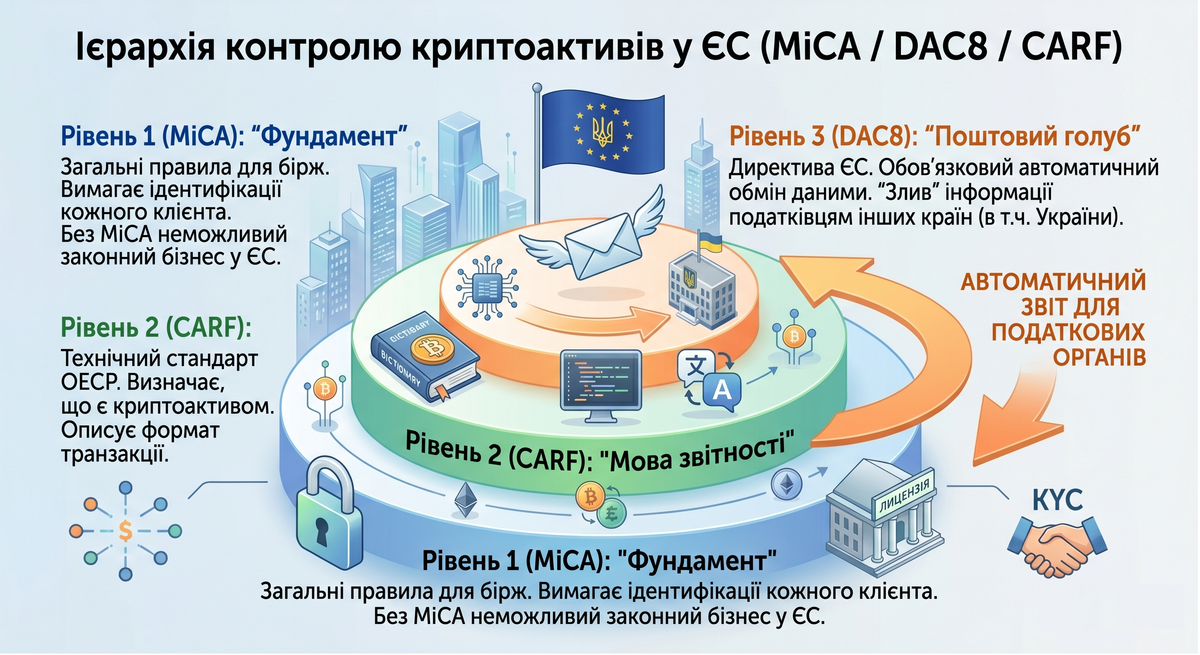
If cryptocurrency used to be a gray area for financial monitoring, today the European Union has built a two-tiered control system. It consists of the MiCA regulation and the DAC8 tax directive. In fact, the EU has created a fully transparent ecosystem where every stage - from identification to taxation - is controlled by regulators. It is important to understand that within this system, the tax authorities can see foreign accounts and digital wallets as clearly as bank statements.
MiCA Regulation: Legalization and rules of the game
MiCA (Markets in Crypto-Assets) is the world's first comprehensive set of rules for the crypto asset market. The purpose of MiCA regulation of EU cryptocurrencies is to make the crypto sphere understandable for banks and safe for investors.
What it regulates: The activities of token issuers and service providers (CASPs) - exchanges, wallets, exchangers.
Why it matters for taxes: MiCA obliges companies to implement strict compliance. This means that verification becomes total, and centralized cryptocurrency exchanges store customer data in accordance with banking standards.
DAC8 Directive: A tax ‘scanner’ for cryptocurrencies
If MiCA sets the rules, then DAC8 (Eighth Directive on Administrative Cooperation) is a tool that will help tax authorities (including Ukraine as part of an international exchange) learn about your digital assets. Thanks to this initiative, the tax authorities can see accounts abroad even if they exist only on the blockchain.
Key features of DAC8:
Automatic exchange. Information about transactions and balances on crypto wallets will be transferred automatically between EU countries and partners (including Ukraine through CARF adaptation).This is another channel through which the tax authorities can see the foreign accounts of Ukrainians.
Wide coverage. Not only Bitcoin or Ethereum, but also regulated stablecoins, tokenized assets, and even some NFTs with investment value are subject to control.
Transparency of self-custodial wallets. The Directive strengthens cold wallet controls, especially when interacting with licensed platforms.
CARF: Total Transparency of Crypto Assets
Many people considered crypto exchanges to be a "safe haven" where they could hide funds from CRS. However, the introduction of the CARF (Crypto-Asset Reporting Framework) finally closes this possibility. This is a new OECD standard that integrates the virtual asset market into the system of automatic exchange of tax information.
Today, the tax authorities see foreign accounts through detailed reporting that includes not only balances but also gross sales amounts.
What exactly will the tax authorities see through CARF?
Unlike bank exchange (where the balance at the end of the year is transmitted), CARF is much more detailed. The tax authorities will receive data on:
Asset type: Bitcoin, Ethereum, stablecoins (USDT/USDC), or NFTs.
Transactions: Not only balances, but also gross amounts from asset sales and exchanges.
Transfer directions: Data on transfers to external (cold) wallets.
Personal data: Full name, address, and tax identification number (TIN) verified through KYC.
Main change -The end of "anonymous" neobanks and cryptocurrencies.
Most Ukrainians use cryptocurrencies (e.g., Bybit, Trustee, or payment system solutions) for everyday spending abroad.
Crypto exchanges are already reporting. Giants like Binance or WhiteBIT have already implemented procedures that are fully CARF-compliant.
Interchange between services. Data on transfers from your wallet to a cryptocurrency card is now part of the reporting received by the State Tax Service.
Neobanks. Revolut and Wise are already integrated into the CRS, and their crypto functions automatically fall under CARF/DAC8 requirements.
Today, the IRS analyzes cryptocurrencies as regular means of payment. The market giants already report according to CARF standards, so any declaration of foreign accounts should include these assets. Ignoring this rule entails fines for undeclared income.
Synergy of CARF, DAC8, and MiCA: What does this mean for a Ukrainian resident?
The connection of MiCA DAC8 crypto and CARF creates a single network where data on transactions on exchanges become available to the State Tax Service of Ukraine automatically. Since the tax authorities can see accounts abroad, the only way to preserve capital is to legalize.
Standard | Role in the system | Control Object |
CARF | OECD Global Standard | Global reporting rules for crypto assets |
MiCA | EU legal framework | Licensing and customer identification (KYC) requirements |
DAC8 | Mechanism of exchange mechanism in the EU | Direct transfer of transaction data to tax authorities |
As Ukraine officially implements EU regulations (in particular, its own legislation based on MiCA is being prepared), data on your transactions on European exchanges (Binance, WhiteBIT, Kraken) will become available to the State Tax Service of Ukraine automatically.
Why the “Just Ride It Out in Crypto” Strategy No Longer Works

Many people believed that withdrawing capital into crypto assets was a reliable way to avoid CRS. However, DAC8 actually does for the crypto world what CRS did for banks. Your digital assets become visible and therefore subject to declaration and taxation.
Criteria | FATCA | CRS | CARF |
Full name | Foreign Account Tax Compliance Act | Common Reporting Standard | Crypto-Asset Reporting Framework |
Who introduced | US | Organization for Economic Organization for Economic Cooperation and Development | Organization for Economic Cooperation and Development |
Year of launch | 2010 | 2014 | 2022 |
Who applies | U.S. citizens and residents (US persons) | Tax residents of participating countriescountries | Users of crypto assets |
Geography | Globally, but under U.S. control | 100+ countries | Globally (in progress) |
What assets | Bank accounts, financial assets | Bank accounts, investments | Cryptocurrencies, exchanges, custodian wallets |
Who reports | Financial institutions → IRS | Banks → local tax authorities → exchanges | Crypto platforms → tax authorities |
Where data is transferred | Internal Revenue Service | Tax authorities of the participating countriestax authorities of the participating countries | Country tax authorities |
Type of exchange | Unilateral (mostly) | Automatic two-way | Automatic |
Level of control | High | Very high | Maximum (new level) |
Why complex schemes with trusts and funds no longer work
Even in 2026, some capital owners are still attempting to use multi-tiered structures – such as CRS trusts or offshore companies – in an attempt to conceal the ultimate beneficial owner. However, as tax authorities can now identify offshore accounts through multi-tiered checks, such methods have lost their effectiveness.
However, UBO (Ultimate Beneficial Owner) rules and modern compliance standards require financial institutions to identify the actual controller regardless of the number of ownership tiers.
If you are the ultimate UBO beneficiary of a structure, the bank determines your tax residency as early as the account opening stage. Subsequently, this information is subject to automatic exchange under the CRS, meaning the tax authorities can see overseas accounts almost instantly.
Important: The CRS covers not only personal accounts but also certain categories of corporate accounts, particularly where income is classified as passive.
What Happens If You Don’t Declare Foreign Accounts?
The question today is not whether the tax authorities will find out, but when they will take action. Since the tax authorities can see foreign accounts, attempting to conceal them in 2026 entails three main risks:
Additional tax assessments and penalties. An 18% personal income tax and a 5% military levy on undeclared income, as well as fines and interest.
Financial monitoring and account freezing. Foreign banks may restrict access to an account in the event of KYC data discrepancies or upon receiving requests from regulators.
Reputational risks. Difficulties or refusal to open accounts with international banks in the future.
How the Ukrainian tax authorities use CRS data: analytical control and practical implications
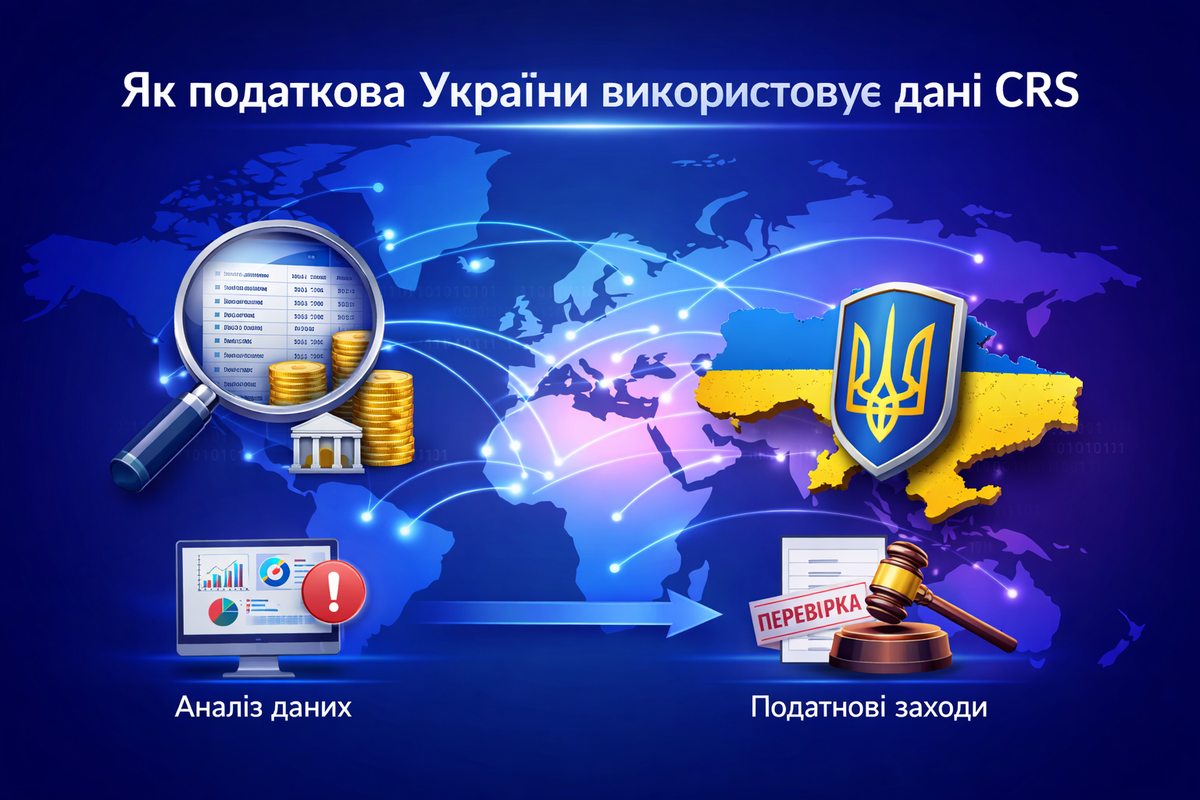
The Ukrainian Tax Service uses CRS data not merely as dry statistics, but as an active analytical tool. The fact that the tax authorities can view overseas accounts enables them to carry out:
Automatic data matching: The system compares data from abroad with your tax returns and information from Ukrainian banks. Any discrepancy automatically generates a ‘risk profile’ for the taxpayer.
Targeted enquiries: In the event of anomalies, the tax authority sends a request asking for an explanation of the source of funds. At this stage, a formal response often becomes the basis for a full audit.
CFC control: The CRS allows the identification of controllers of foreign companies. Even though there is currently a grace period for CFC penalties, the tax authorities are already compiling a vast amount of data for future additional assessments.
Reverse control: The exchange works both ways. If you have changed your residency but left accounts in Ukraine, be prepared for enquiries from foreign tax authorities.
What to do now: legalization strategy

In this era of global financial transparency, we do not recommend seeking ways to conceal assets. The best strategy is proper legalisation and structuring.
Determining tax residency. Clearly establish your status. Key criteria: length of stay (183+ days), centre of vital interests, place of business. It is precisely this data that banks use for KYC and report under the CRS.
Audit of foreign accounts. Check all your accounts with banks, payment systems and crypto exchanges to see what data about you is recorded there. Check which tax identification number (TIN) you provided during verification – it is to this jurisdiction that the information will be transferred. It is through this data that the tax authorities identify residents’ foreign accounts.
Tax returns and CFC reporting. If you own a foreign company, ensure that CFC reporting is submitted correctly and on time. Even where preferential regimes apply, information is already being accumulated in the tax authorities’ databases.
Tax payment and optimisation through double taxation treaties (DTTs). Make use of double taxation treaties. This is a legal tool for reducing your tax burden, provided you can properly confirm your residency.
Preparing Source of Funds documentation. Put together a package of documents in advance to confirm the lawful origin of your funds. This is your main line of defence in the event of an enquiry from a bank or the tax authorities.
The global financial system in 2026 no longer leaves room for uncertainty. Automatic data exchange, beneficiary control, and the integration of crypto assets into tax reporting are creating a new reality in which any asset is subject to analysis and can be identified.
In this environment, the key factor for security is not the complexity of the structure, but its transparency and soundness. The winner is the one who stays one step ahead: understands their tax status, controls their assets and can confirm their origin. It is precisely this approach that allows not only to minimise risks, but also to ensure long-term stability.