Purchasing real estate abroad has long been a common practice for Ukrainians, whether for investment, relocation or purchase of housing for personal use. At the same time, one of the key stages of such a transaction is opening a bank account in Europe, through which payments are made to the seller or developer.
While a few years ago the main issue was the choice of the property itself, today almost every consultation begins differently: in which foreign bank to open an account for the purchase of real estate and how to legally transfer funds from Ukraine abroad. Clients are interested in the mechanics of making a payment.
In most cases, these financial and legal nuances determine how quickly the transaction will take place and whether it will be possible to make a payment without additional checks, blockages or critical delays by a foreign bank. A properly chosen banking strategy before signing any agreements or making advance payments greatly simplifies the transaction and eliminates the risks of disruption.
Why the banking issue is more important than the choice of an object today

The real estate market in Poland, Montenegro, Spain and Cyprus is actively accepting Ukrainian buyers. The problem now is not a lack of supply, but rather a problem of physically and legally making payments within the European financial system.
Due to the introduction of martial law and currency restrictions established by Resolution of the NBU Board No. 18 dated 24.02.2022, a special regime for cross-border currency transactions is in place in Ukraine. Within this regime, most direct transfers of individuals abroad, in particular for the purchase of real estate, are significantly limited or require special conditions of execution in accordance with the current currency regulation.
This means that even if you have official money in a Ukrainian bank, you cannot simply "click a button" in the application and pay for the apartment you have chosen in Warsaw or Limassol.
The only legal mechanism that really works is open an account in a foreign bank, physically transport cash there in compliance with all the rules of bilateral declaration, pass strict banking compliance and pay the seller from your own European account.
That is why choosing a bank is the first and most important step in the legal structuring of a transaction. In practice, it is a foreign bank that checks in detail:
The legality and source of the investor's capital;
The future legal purpose and purity of the payment;
The maximum amount of a one-time or phased transfer of funds;
The possibility of making an unimpeded international transfer to the seller within the European Union.
In our experience, in more than 70% of transactions for the purchase of real estate abroad, the main questions arise not at the stage of choosing an object, but when opening an account in a foreign bank, confirming the Source of Funds and arranging payment to the developer.
If you do not calculate the requirements of bank compliance in advance, there is a risk that the bank for the purchase of real estate abroad may suspend the transfer of funds or request additional supporting documents. In such cases, there may be delays in making the payment, which, in turn, may affect the timing of fulfillment of obligations under the contract with the developer or seller and create risks to the preservation of the reservation conditions for the object.
During the initial consultation, clients most often ask us the following practical questions:
Which foreign banks are the most reliable and loyal to Ukrainians today when buying housing or commercial properties?
Where can you open an account remotely (without traveling abroad), and which countries require only personal presence?
What documents does European compliance request to confirm the source of funds?
How to take cash out of Ukraine and declare it at the border in a correct and legal way so that a foreign bank does not refuse to accept funds?
What should be taken into account and agreed with the cash department abroad before directly depositing a large amount?
Top 3 banks for opening a real estate account

According to Maira Consult's experience, three banks remain the most convenient for Ukrainian clients planning to buy real estate in Europe. They are chosen not only because of the possibility of opening an account for a non-resident, but also because of the convenience of further depositing funds, passing bank compliance and making an international transfer to the seller of real estate.
Zapad Bank (Montenegro)
Zapad Bank is often used by clients who need to open an account in a reliable bank with the possibility of further cash deposits and international transfers to the seller of real estate. The bank is loyal to non-residents and works with requests for the purchase of real estate both in Montenegro and in other European countries.
The main advantage: The account is opened completely remotely, without the client's personal presence in Montenegro. This is critical for investors who are currently in Ukraine or do not have the opportunity to spend time traveling abroad: Cash deposits are absolutely possible, but strictly after prior approval from the institution's compliance department.
Who is it for: Those who want to open an account as quickly as possible and without leaving home in order to accumulate money for further cashless payments throughout Europe.
Bank of Cyprus (Cyprus)
Bank of Cyprus is one of the most convenient options for those who want to go through the procedure of opening an account remotely. Most often, it is chosen by clients who need an account for further payments for real estate in Europe without personal travel at the initial stage.
The main advantage: Possibility of remote account opening without traveling to Cyprus.
Working with cash: Cash is accepted, but strictly under the contract of reservation or purchase and sale of a specific property.
Who is it for: For real estate transactions in Cyprus and large international transfers, where every step is confirmed by official financial documents.
Erste Bank (Poland)
Erste Bank is one of the most popular banks among Ukrainians due to the clear account opening procedure, accessibility of branches and convenience of further SEPA transfers within the European Union. Opening an account usually requires the client's personal presence at an Erste Bank branch.
Main advantage: Minimal service fees, fast internal procedures (1-2 business days) and the convenience of instant free SEPA transfers within the European Union.
Cash handling: Cash deposits are possible through the bank's cash desk. All documents must be submitted with a sworn translation into Polish.
Who is it for: Investors who are ready for a personal visit and plan to purchase real estate in the EU through the most profitable SEPA transfers.
Important nuance: Unlike Montenegro and Cyprus, Polish banks strictly require a personal presence in a branch, as well as a PESEL tax number and official confirmation of residence to open an account for Ukrainians. We help you to legally obtain a PESEL number and register a residence permit in Poland before you visit the bank.
For more details on all the nuances of opening an account in a Polish bank, please refer to our guide Opening an account in a Polish bank.
Comparative analysis of bank conditions and tariffs (Actual for 2026)
Comparison Parameter | Zapad Bank (Montenegro) | Bank of Cyprus (Cyprus) | Erste Bank Polska (Poland) |
Format of opening an account | Remote (without going abroad) | Remote, without traveling abroad. It is possible to certify documents at the Cyprus Consulate | Only a personal visit of the investor to the branch |
Cash acceptance at the cash desk | Yes (requires prior compliance approval) | Yes (strictly under the accompanying facility reservation agreement) | Yes |
Speed of document review | Express (5 to 7 business days) | Medium (2 to 4 weeks due to deep KYC) | Operational (1-2 working days in case of personal presence) |
Account opening fee | €540,00 (one-time fee for non-resident individuals) | €500,00 | 0 PLN (Free) |
Service fee | First 6 months. - 0; from the 7th month - €15,00/month. | €35,00 per quarter | 0 - 6 PLN per month (depending on balance or transactions) |
Cash deposit fee | According to the tariff of the national. transactions: 1.00% (min. €3.00) | 1.00% of the amount (max. €50 for amounts over €15,000) | 0 PLN (Free) for basic and premium packages |
Fee for SWIFT transfer to the developer | 0,15% of the amount (max. €200.00) | 0.25% of the amount (min. €30 / max. €500) + €50 processing fee | 0.2% - 0.25% of the amount (min. 20-28.5 PLN / max. 200 PLN) |
Requirements for legalization of documents | Notarized translation into Montenegrin/English | Obligatory Apostille and certified translation | Notarized translation into Polish (sworn translator) |
Specific requirements of the jurisdiction | No additional requirements | No additional requirements | Obligatory PESEL and Polish residence permit |
Official NBU rules on cash export and declaration
According to the current official explanations and regulationslegal acts National Bank of Ukraine, resident individuals move cash currency outside Ukraine under the following strict rules:
Up to the equivalent of EUR 10,000: in a total amount not exceeding the equivalent of EUR 10,000 on the day of movement across the customs border of Ukraine (export), funds are transported without submitting supporting documents.
In the equivalent of more than EUR 10,000: in the total amount exceeding the equivalent of EUR 10,000 per day of movement across the customs border of Ukraine (export), export is carried out exclusively on the basis of supporting documents.
What documents are required by customs and the NBU?
In order to move cash currency out of Ukraine in an amount exceeding the equivalent of EUR 10,000 on the day of movement, the documents provided must clearly confirm:
Withdrawal of cash by an individual from their own bank accounts;
Conducting a currency exchange transaction with this cash (if such a transaction is carried out).
Important according to the NBU:
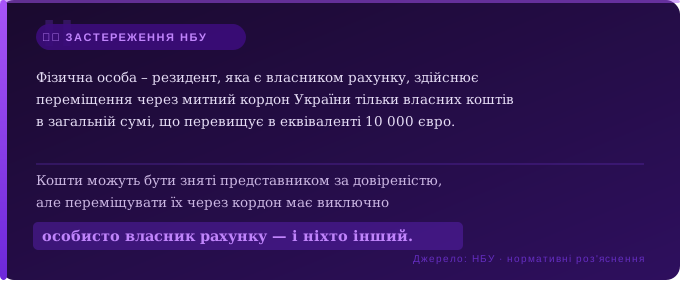
A resident individual has the right to export only his/her own funds across the customs border of Ukraine if their amount exceeds the equivalent of EUR 10,000 as of the day of transportation.
In this case, even if the funds were withdrawn from a Ukrainian bank by another person under a power of attorney, such a representative is not entitled to export this money outside Ukraine. Only the account holder himself is allowed to transfer cash across the border.
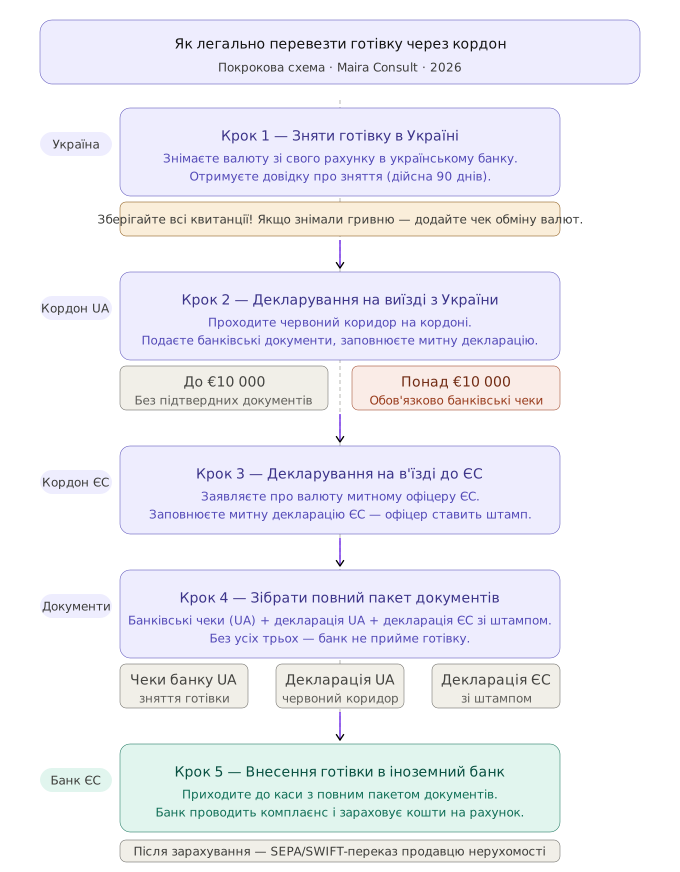
Step-by-step scheme of legal transit of money to a foreign bank
Official withdrawal in Ukraine. You withdraw currency from your account. Be sure to get a cash withdrawal certificate from the bank (remember, it is valid for customs for 90 calendar days). If you withdrew hryvnia and then exchanged it for euros, you should attach a receipt of the currency exchange transaction.
Declaration on departure from Ukraine At the Ukrainian border, you go to the "red corridor", provide bank supporting documents and fill out a written customs declaration.
Declaration at the entrance to the EU When crossing the European border (for example, on the border of Ukraine with Poland), you must declare the presence of currency to the European customs officer and fill out an EU customs declaration, where the officer puts a stamp.
Visit to the bank's cash desk abroad. Only after that you have a complete package of documents (Ukrainian checks + Ukrainian declaration + European declaration), which will allow a foreign bank to accept money into the account.
Technical nuances of working with a cash desk abroad
To deposit cash through a foreign bank's cash desk, you need to notify us in advance. We discuss this possibility with the bank, book a time and agree on the limits. Consider the following factors:
Some branches, due to internal cash desk limits and security rules, cannot process the entire large amount in one day.
You need to understand that the limits of a particular branch may ask you to go to the bank several times (split the amount into 2-3 days).
Depending on the amount and the bank's internal procedures, in some cases, additional verification or approval of the transaction may be required, in particular, with the involvement of the head office when depositing funds through the cash desk.
Procedure for opening an account abroad for the purchase of real estate
In practice, European banks always analyze two things first: the purpose of opening an account and the source of funds. The speed of account opening and further compliance depends on the quality of preparation of these two blocks. The European banking system is much more formalized than the Ukrainian one, so any inaccuracy in the documents or explanations may lead to additional requests or delays in consideration.
Questionnaire and goal setting
Filling out an internal questionnaire: In our profile questionnaire, you must clearly state the purpose: "opening an account for the accumulation of funds and subsequent purchase of real estate". This is important because the bank for buying real estate abroad immediately understands the purpose of future receipts and payments and will not block the transaction as suspicious.
Case analysis: Our lawyers study your financial history in detail to prevent possible questions from bank analysts and eliminate all risks in advance: We communicate with the financial institution on our own, sending scanned copies of documents to get a preliminary "green light" without your personal presence: After receiving preliminary approval from the bank, we organize a personal meeting with the bank manager. At this meeting, all the nuances are finalized, the necessary documents are signed, and your account is opened.
When it comes to account opening, not only the official requirements of the bank are important, but also a practical understanding of its internal procedures. At Maira Consult, we are well aware of how banks analyze customer profiles, what they pay attention to during compliance, and how to properly structure the information provided by the client in a free form to meet the expectations of the banking department.
Preparation of documents on the source of funds
At this stage, the bank assesses the client's overall financial history. Maira Consult's practice shows that the complexity of this stage directly depends on where your capital has been accumulated:
If you officially receive regular income or dividends from a foreign company directly to your current foreign account, compliance for buying real estate will be as simple as possible. To buy real estate abroad, it is enough to provide the bank with recent bank statements, a contract with your employer, tax reports, and a decision to pay dividends. The money is already within the European financial system, so there are usually no additional questions."
A completely different situation arises if your capital is kept in Ukraine and you need to physically withdraw cash and take it abroad due to NBU restrictions. For a European bank, the classic Ukrainian scenario - withdrawing currency at a cash desk in Kyiv and bringing it in a suitcase to Warsaw - is a marker of increased risk.
The most common legal scenarios for capital confirmation, which we prescribe in detail for compliance:
Sale of real estate in Ukraine: a purchase and sale agreement, a notarized translated contract, as well as a bank statement of receipt of funds from the buyer in Ukraine are provided.
Income from business / individual entrepreneur: tax returns for the last 2-3 years, official bank statements of the sole proprietorship and contracts with key counterparties are prepared.
Dividends from the company: the bank asks for the company's financial statements, an official decision of the shareholders' meeting on the payment of dividends, a tax return on the payment of taxes on dividends, as well as confirmation of the ownership structure of the company.
Accumulated funds (cash): bank statements of withdrawals from accounts, original documents on currency purchases, and legal customs declarations (Ukraine + EU) are provided.
A client sold an apartment in Kyiv for $120,000, but at the time of the transaction she was outside Ukraine. A notarized power of attorney was drawn up for her mother as an authorized person. The buyer transferred the funds in foreign currency to a Ukrainian bank account. The authorized person withdrew cash daily in accordance with the applicable limits, keeping all bank receipts.
After returning to Ukraine, the client personally collected the full package of documents: the sale and purchase agreement, bank receipts, power of attorney and a sworn translation of the agreement into Polish.
The funds were then declared at the border of Ukraine and the EU together with supporting documents on the origin of the funds. The declaration, receipts and translated agreement were checked at the Polish customs.
After submitting the full package of documents to the bank in Poland and passing the compliance check, the funds were successfully credited to the client's account as a transparent confirmed source of capital.
Crediting the funds and using them to purchase real estate
After the bank accepted the funds and completed the compliance check, the account becomes fully active. The client can then:
Make a seamless SEPA or SWIFT transfer to the seller's account;
Pay for the property directly to the developer under the contract;
Use the account for further operational support of the property and payment of utilities.
Typical mistakes that lead to bank rejection
We have seen them all in our daily practice. Here are the most costly ones that can completely block your investment plans:
Opening an account "without a purpose" - if you do not clearly indicate the purpose of the account in KYC questionnaires, the bank simply does not understand the essence of large transactions and instantly blocks the account at the first large receipt.
Take cash without a bilateral declaration - if the amount exceeds €10,000 and you decide to ignore the "red corridor", EU customs has every right to confiscate the funds. In addition, a European bank will simply not accept money without official stamped customs declarations.
Deposit cash without prior arrangement with the bank - you cannot come "off the street" with a bag of euros or dollars to the cash desk. The cashier will either immediately refuse you due to the limits of the branch, or the transaction will be suspended by financial monitors for an indefinite period until the circumstances are clarified.
Submit documents without translation or with the wrong legalization format - each bank has strict requirements (in Montenegro - notarized translation, in Poland - certified translation). If you make a mistake, the bank will return the package for revision, and your agreement with the developer will simply "hang up."
Try to pass compliance on your own without understanding the requirements - ill-conceived or chaotic answers to bank analysts will lead to your being put on the institution's internal "gray list. After that, it becomes extremely difficult to invest legally in this jurisdiction.
How to protect your capital when buying a home abroad

Opening an account for buying real estate abroad is not a technical formality, but a full-fledged financial and legal procedure that requires proper preparation and understanding of European compliance requirements.
In 2026 buying real estate abroad and opening an account in a foreign bank is primarily about thorough legal preparation of the financial route, not just technical payment for the object. Strict NBU restrictions and European banking compliance require absolute transparency from the investor.
The main task at the initial stage is to structure the documents correctly, go through the bank's pre-approval procedure and ensure legal bilateral cash declaration at the border. Any chaotic actions or mistakes in the paperwork can lead to blocking of transactions or refusal to cooperate.
The Maira Consult team helps you go through this process without risking your capital. We fully accompany the process: from analyzing your financial history and communicating with European analysts to opening an account during a meeting with a bank manager. Our professional approach ensures that the transfer of funds and the final settlement with the seller will be carried out safely, quickly and in full compliance with international law.