Lithuania consistently ranks among the top five most business-friendly jurisdictions for starting a business in the European Union. The reasons for the high level of interest from foreign entrepreneurs are simple: fully remote registration, favorable tax laws, a fast process, and the official status of a European company - which is critical for stable operations with European counterparties and international payment systems.
The first and most important question every founder faces before launching a business is: which legal form to choose - MB or UAB?
The wrong choice at the initial stage can cost a business between €5,000 and €15,000 per year in the form of hidden operating costs or strict regulatory restrictions. We’ve compared the key differences between an MB and a UAB, analyzed real-world financial scenarios taking into account the 2026 tax incentives, and will help you determine the best path for your company.
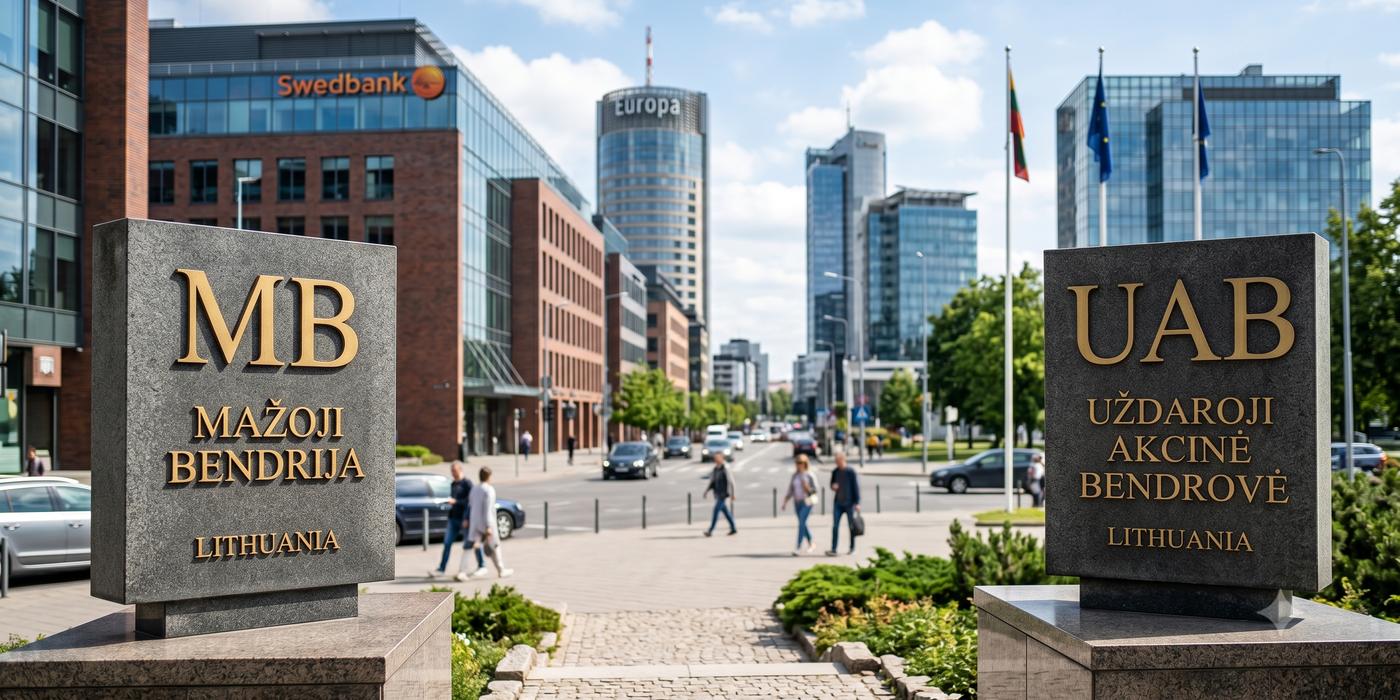
Main Company Structures in Lithuania for Non-Residents: MB and UAB

Lithuanian law offers several options for conducting business, but two forms are the most popular among foreign investors and entrepreneurs:
UAB (Uždaroji akcinė bendrovė) - a closed joint-stock company, which is the direct equivalent of a Ukrainian LLC (limited liability company).
MB (Mažoji bendrija) - a small partnership. This is a simplified, modern form of doing business, created specifically for small businesses, startups, and freelancers.
How does an MB differ from a UAB in Lithuania?

Registering a UAB in Lithuania: The Classic Company Structure for Large-Scale Projects
Establishing a UAB in Lithuania is the standard, classic, and most straightforward company structure. It is ideal for conducting any type of international business, operating in the EU’s internal market, and formally hiring a large staff; it also enjoys the highest level of trust from European banks, business partners, and investors.
Legal and financial features of a UAB:
Founders. Both individuals and legal entities (including foreign companies) can establish a UAB in Lithuania. A non-resident of Lithuania may be the sole shareholder.
Liability. Limited - the founders are liable for the company’s obligations solely to the extent of their contributions to the authorized capital.
Authorized Capital. The minimum amount is €1,000. It must be fully contributed and paid into a special escrow account before submitting documents for state registration.
Management and Staff. A director is required. There are no residency requirements (a Ukrainian citizen may serve as director), but the director must be officially employed under an employment contract.
Salary Expenses. The minimum gross salary for a director in 2026 is €1,153, which entails mandatory monthly payments of taxes and social security contributions.
Transfer of Shares. Shares of a UAB may be freely sold, gifted, or pledged as collateral.
Profit Distribution. Dividends may be paid to shareholders only after the end of the fiscal year, the preparation of financial statements, and the payment of income tax.
Taxation. The standard income tax rate is 17%, and there are no restrictions on the company’s annual turnover.
Who is best suited to establish a UAB in Lithuania?
Large trading and logistics companies
IT businesses with a complex structure
SaaS projects
Companies planning to attract venture capital
For activities subject to mandatory licensing in the EU
Registering an MB (Mažoji bendrija) in Lithuania: Flexibility and Minimal Costs for Small Businesses

Setting up an MB in Lithuania today is one of the fastest ways to legally launch a business in the EU. An MB (Mažoji bendrija, or Small Partnership) is a relatively new but already extremely popular business structure in Lithuania, created as an alternative to sole proprietorship to minimize registration and administrative costs.
Legal and financial features of an MB:
Founders. Only individuals (up to 10 people) can establish an MB in Lithuania. A non-resident of Lithuania may act as the sole founder of the company.
Liability. Limited - MB members are liable only to the extent of their capital contributions.
Authorized Capital. There are no statutory requirements for a minimum capital amount (formally, starting at 1 €). It is not necessary to establish a capital account prior to registration.
Management. The company may be managed directly by the members’ meeting or by an appointed director (who may be the sole founder and a non-resident).
Employment relationships. An MB member cannot enter into a traditional employment contract with their own company. Instead, interactions and payments are carried out on the basis of civil law service agreements (between the manager and the MB). This exempts the company from the obligation to pay the minimum wage (€1,153) and the corresponding monthly taxes, provided the business is still in its early stages.
Preferential Taxation. MBs are subject to a reduced corporate income tax rate of 7%, provided that the company’s annual turnover does not exceed €300,000 and the number of employees does not exceed 10.
Flexible dividends. The main advantage of establishing an MB in Lithuania is the ability to make advance profit distributions (monthly or quarterly) among shareholders without waiting for the end of the fiscal year. However, the total amount of such payments is capped at 100,000 euros per year.
Who is best suited to set up an MB in Lithuania?
freelancers
developers
small startups at the MVP stage
consulting agencies
small e-commerce projects
sole proprietors
Why not an IĮ (Individuali įmonė) - a sole proprietorship in Lithuania?
When considering business structures in Lithuania, foreign entrepreneurs sometimes ask about the sole proprietorship - Individuali įmonė (IĮ).
Formally, this structure has advantages: a single founder who is a natural person, no start-up capital requirements, and the ability to freely withdraw profits without complex corporate procedures.
However, the IĮ has one critical and irreversible drawback - the owner’s unlimited personal liability. Unlike an MB or a UAB, where liability is limited to the owner’s contribution to the company, the owner of an IĮ risks all of their personal assets: bank accounts, real estate, and vehicles. In the event of debts or legal claims against the company, enforcement automatically extends to the founder’s personal assets.
That is why, in 2026, a sole proprietorship in Lithuania is practically not considered a viable option for non-residents and Ukrainian entrepreneurs. Establishing an MB in Lithuania offers similar flexibility - a low entry barrier, no capital requirements, and simplified reporting but with limited liability for shareholders and a significantly higher level of trust from banks and business partners.
The conclusion is simple: if you’re choosing between an IĮ and an MB in Lithuania, choose to open an MB in Lithuania. An IĮ offers no additional protection, and the risks are disproportionately higher.
Comparison Table: MB vs UAB
Criterion | MB | UAB |
Liability | Limited Liability of Members | Limited Liability of Shareholders |
Registration Speed | 3–5 business days | 5–8 business days |
Remote nature of the process | Fully remote | Fully remote |
Authorized Capital | Starting at 1 €, no payment requirements | From 1,000 €, must be paid prior to registration |
Founders | Individuals only (up to 10 participants) | Individuals and legal entities (no restrictions) |
Director | Optional | Required |
Hiring Employees | Restricted to participants | Full-time employment |
Accounting | Reporting may be required once a year | Monthly reporting |
Dividend payments | Monthly profit distribution to participants is possible | Payments made only after the end of the fiscal year and the submission of financial statements |
Attracting investors | Less convenient for investors | Convenient for investing and selling shares |
Sale / transfer of shares | Restricted | Unrestricted |
Suitable for licenses | Depends on the field of activity | No restrictions on obtaining licenses |
When an MB is more advantageous than a UAB: real-world calculations (2026)

As of January 1, 2026, a crucial legislative provision is in effect in Lithuania that makes the MB structure even more attractive: a newly established small company (including an MB) with annual revenue of up to €300,000 is entitled to a 0% corporate income tax rate for the first two tax periods. Starting in the third year, the rate transitions to a preferential rate of 7% (provided the revenue thresholds and number of employees remain unchanged).
Below are detailed financial simulations showing the actual difference in the tax burden.
Table A. MB’s Tax Advantage by Year (assuming a stable annual turnover of 100,000 €)
Years in Business | Annual Revenue | MB Rate | MB Tax | UAB Rate | UAB Tax | Savings with MB |
Year 1 | 100,000 € | 0% | 0 € | 17% | 17,000 € | 17,000 € |
Year 2 | 100,000 € | 0% | 0 € | 17% | 17,000 € | 17,000 € |
3rd year | 100,000 € | 7% | 7,000 € | 17% | 17,000 € | 10,000 € |
3rd year * | 400,000 € | 17% | 68,000 € | 17% | 68,000 € | 0 € |
*If the revenue limit of 300,000 € is exceeded, MB automatically loses its right to the tax break and is taxed at a rate of 17%.
Table B. Comparison of the tax burden starting in the 3rd year of MB’s operations
Net Profit | MB Tax (preferential rate 7%) | UAB Tax (standard rate 17%) | Net savings in favor of MB |
30,000 € | 2,100 € | 5,100 € | 3,000 € |
50,000 € | 3,500 € | 8,500 € | 5,000 € |
100,000 € | 7,000 € | 17,000 € | 10,000 € |
300,000 € | 21,000 € | 51,000 € | 30,000 € |
400,000 € | 68,000 € | 68,000 € | 0 € |
The conditions for obtaining the zero rate include additional eligibility criteria (in particular, the company must not be controlled by corporate groups). Final eligibility should be verified on a case-by-case basis prior to registration.
How much does it cost to set up an MB or UAB in Lithuania: a comparison of actual costs

In addition to general differences, there are real financial criteria that significantly influence the choice.
Criterion | MB | UAB |
Registration fee | 2,300–2,500 € | 2,600–3,000 € |
Authorized Capital | Formally (starting at 1 €) | Required (minimum of 1,000 €) |
Director’s salary | Optional | Required (starting at 1,153 €/month + taxes) |
Accounting costs | Simplified (starting at 100 €/month or annual reporting) | Mandatory full-scope accounting (starting at 300 €/month) |
Income tax | 0% (first 2 years) → 7% for revenue up to 300,000 €/year | 17% regardless of revenue |
Payroll taxes and social security contributions | Only if a salary is paid to the director | Mandatory monthly |
Total monthly expenses | Starting at 100 € | From 400–500 € |
The lawyers at Maira Consult always emphasize the importance of accounting - it is the most underestimated cost factor. A UAB requires ongoing support from a certified accountant, the submission of monthly reports to the tax authority (VMI) and the social insurance fund (Sodra), as well as the submission of monthly VAT returns if the company has obtained a VAT number. Overall, establishing a UAB in Lithuania costs 2–3 times more than an MB.
Step-by-Step Guide: How to Start a Company in Lithuania for Ukrainians and Non-Residents

Regardless of the chosen legal form, the process of starting a business in Lithuania for citizens of Ukraine and other countries can be completed entirely remotely.
There are two ways to register:
through the state electronic registry (available only to residents with a Lithuanian digital signature or Smart-ID) and
through a local notary public via a power of attorney (the best option for foreigners).
Let’s look at the clear sequence of steps for remotely starting a business in Lithuania:
Name verification and reservation
The company name can be in Lithuanian or English. It must be checked for uniqueness in the state registry of the Republic of Lithuania (Registrų centras) and reserved.
Determining business activities (NACE codes)
Activity codes are selected according to the European classification. This is critically important not only for the articles of incorporation but also for the subsequent successful completion of compliance procedures (KYC) at financial institutions.
Preparation of Incorporation Documents
Lawyers draft the company’s customized statutory documents in accordance with the agreed-upon structure:
Steigimo aktas (Articles of Incorporation or Memorandum of Association);
Nuostatai (Company Bylaws).
The documents are drafted taking into account the ownership structure, the composition of the shareholders, and the chosen company form (MB or UAB), after which they are forwarded to the founders for signing.
Notarization in the founder’s country
The finalized draft documents and the power of attorney for the Lithuanian representative are sent to the founder via email. The founder and director have the following notarized in their home country:
A power of attorney based on the template we provide;
Copies of the foreign passports of all shareholders and beneficiaries.
An important detail for Ukrainians: In accordance with the current bilateral agreements between Ukraine and Lithuania, notarization alone is sufficient for Ukrainian documents - an Apostille (legalization) is not required, which significantly saves time and money.
Completion of KYC and AML Procedures
All founders and ultimate beneficial owners undergo mandatory compliance checks in accordance with EU directives. This includes filling out detailed questionnaires, verifying the sources of funds (for UAB capital), and identifying individuals.
Payment of Authorized Capital (exclusively for UABs)
A temporary escrow account is opened for the UAB. If you plan to establish a UAB in Lithuania, this step is a mandatory part of the registration process. Traditionally, this is done at a bank, but today the fastest and most efficient tool for remote business is the Paysera payment system (which holds an EMI license and has physical branches in Vilnius). The capital (starting at €1,000) must be paid exclusively from the shareholder’s personal account. After the transaction is completed, an official confirmation statement is generated.
Submission of Documents and Final Registration in Vilnius
The originals of the certified documents are sent via courier service (DHL/Nova Poshta) to lawyers in Vilnius. We arrange for a certified translation into Lithuanian, have the package notarized by a local notary, and submit it to the state registry. At this same stage, information about the ultimate beneficial owners must be entered into the JADIS and JANGIS state subsystems.
What do you receive upon completion of registration?

The Lithuanian State Register is open and public. You can check the company’s status directly on the official website of Registrų centras.
The standard package of official corporate documents (in electronic format with the registrar’s digital signature) includes:
Articles of Incorporation (Steigimo aktas).
Company Bylaws (Nuostatai).
Extended extract containing the company’s registration data (ESI).
An extract regarding the ultimate beneficial owners from the Jadis and Jangis systems.
Official consent to provide a legal address from the owner of the commercial real estate.
When registering a company, you must provide an official phone number and email address. The law allows foreign phone numbers, but we strongly recommend obtaining a local Lithuanian number. This ensures the smooth and immediate receipt of SMS codes for authorization in the VMI tax portal.
Case Study: Registration of a UAB with an International Founder Structure
Modern business is often cross-border. Having founders with different nationalities is not an obstacle to remotely establishing a company in Lithuania.
Our law firm handled a case involving the registration of a UAB with a complex structure: the first founder is a Ukrainian citizen, the second founder is a Polish citizen, and a Lithuanian resident was appointed as director.
How was the procedure carried out?
The founders (Ukrainians and Poles) executed notarized powers of attorney and certified copies of their passports in their respective countries of residence. The original documents were sent by courier to our office in Vilnius. Our lawyers notarized the founding documents in Lithuania. After the shareholders remotely deposited the authorized capital into the account, the Lithuanian director signed the final set of documents using his mobile electronic signature (Mobile-ID). The company was successfully registered in the registry without the need for the founders to meet in person.
Common Mistakes When Choosing a Business Structure in Lithuania

Registering an MB with a plan to quickly attract investors. Only individuals can be MB shareholders. No venture capital fund or legal entity partner can become an MB shareholder. If you’re launching a startup with future investment rounds in mind, choose only a UAB.
Unforeseen administrative costs for a UAB. Entrepreneurs often believe that registration fees are the only startup costs. However, mandatory monthly payments (the director’s salary and taxes on it, as well as accounting services) begin to accrue from the very first month, even if the company has not yet commenced active operations.
Ignoring the payout limit for MB members. The monthly advance distribution of profits in an MB is capped at €100,000 per year. If your turnover requires the withdrawal of larger amounts of funds, this limit can become a serious obstacle and force you to switch to a UAB structure.
Incompatibility of the company’s legal form with key counterparties. Certain large European marketplaces, B2B platforms, and payment gateways may refuse to work with an MB during the KYC process due to the absence of a traditional employed director and shareholder structure. Always check the requirements of your main partners in advance.
The illusion of tax-free withdrawals via a civil law service contract in an MB. Since MB does not have a traditionally employed director, founders often believe that payments under a civil law service contract (paslaugų sutartis) can be withdrawn tax-free. This is a common and costly mistake. Such payments are subject to income tax (GPM) at a rate of 15%, and in some cases, additional obligations arise regarding social insurance contributions (Sodra) - specifically, if the manager has not confirmed insurance coverage in another EU country. Incorrect structuring of these contracts from the outset is usually discovered during the very first tax audit and leads to additional tax assessments and penalties.
Company registration at “mass” registered addresses (without substance). A registered address in Lithuania is required to enter a company into the registry. By purchasing the cheapest options for mass-registration addresses (where thousands of companies are registered), you come under close scrutiny. This becomes the main reason for payment systems and banks to immediately refuse to open an account, and it also creates serious difficulties when obtaining a VAT number from the tax office, since the company is classified as “transit” or “fictitious.”
Confusion between the three methods of withdrawing funds from an MB. MB founders often confuse three different methods of withdrawing funds: payments under a civil contract (CPS), payments for personal needs (code 02), and dividends. The most costly confusion is between code 02 and dividends. Payments under code 02 are treated for tax purposes as earned income: in addition to the basic GPM, VSD and PSD contributions are levied (starting in July 2026 - on 90% of the withdrawn amount). In contrast, the correct classification of advance dividends is subject only to a 15% GPM without any social security contributions. The difference in the actual tax burden between these two approaches can reach 25 - 30% of the payment amount. Choosing the wrong code at the outset is usually discovered during the very first audit.
Errors in the corporate structure at the initial stage always result in financial losses. Reorganizing a business in Lithuania requires time, payment of fees, and repeating notarial procedures.
Case Study: How to Open an Account Without “Substance”
A client from Ukraine is registering an MB for consulting activities-without a physical office in Lithuania or local employees at the outset. The director personally visited SEB and Swedbank in Vilnius. Both banks declined for the same reason: the lack of a verified economic connection to the country (Substance).
We suggested opening a corporate account with Paysera. Since the MB did not need a savings account, Paysera immediately became the primary payment tool. The strategy was simple: 3-4 months of active operations through Paysera, the first transactions with European counterparties-and only then a resubmission to traditional banks with a real transaction history in hand. It is precisely this history that serves as the main argument during the bank's compliance review.
It is important to understand that Lithuanian companies are not legally tied to a specific bank or country of operation. You can open an account at any financial institution within the EEA- Revolut Business, Wise, MultiPass and other foreign banks - depending on the specifics of your business.
MB or UAB in Lithuania: The Final Choice for Your Business
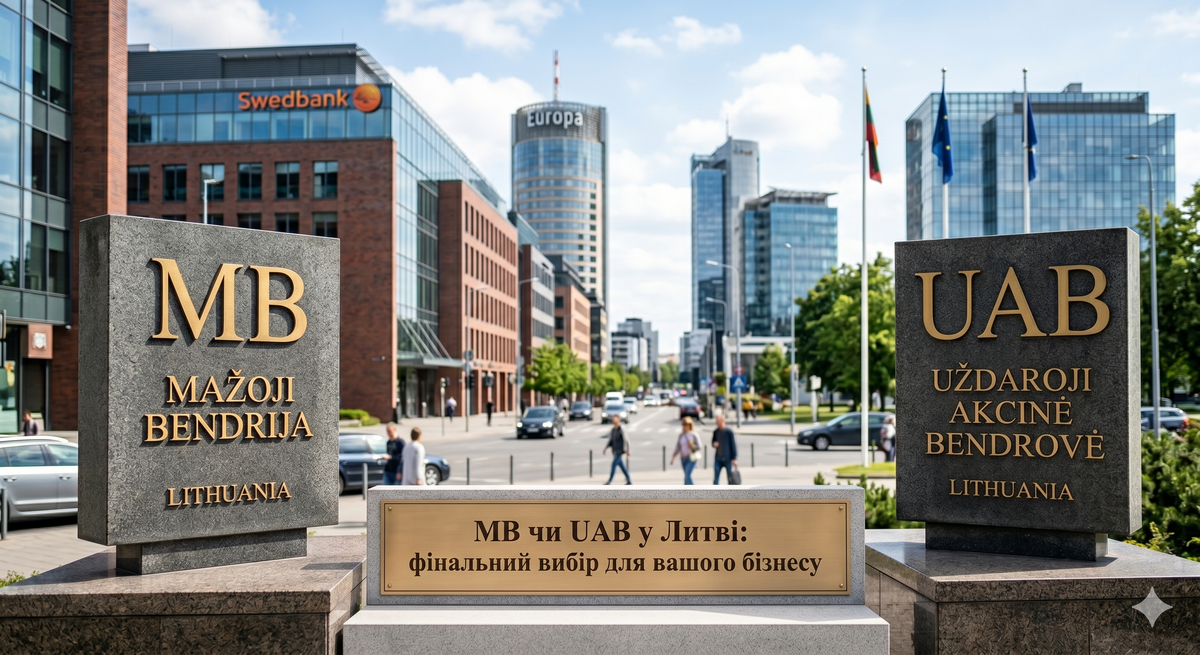
MB is the optimal starting point for those who want to minimize operating costs and test their business model in the EU without undue financial pressure. Given the zero tax rate for the first two years, this is one of the most cost-effective startup structures in the EU today. UAB is the choice for scaling up: high turnover, attracting investors, and licensed operations.
The key is to make this choice consciously before submitting your documents. Reorganizing an already registered company in Lithuania costs time, money, and nerves.
Before making a decision, consider three factors:
the requirements of your key counterparties regarding the company’s legal form
turnover growth trends relative to the €300,000 threshold for an MB
and your strategy for opening a bank account, taking into account banks’ “substance” requirements
If you’ve already decided on the legal form or want to learn more about the procedure and cost, see the page for details company registration in Lithuania.